PTP at the UN

2020 Joint Civil Society Statement on Youth Engagement and Peace, Disarmament and Non-Proliferation Education

Written Version for Delivery on 13 October 2020 to the UN General Assembly First Committee (Disarmament and International Security)

Includes all signatories as of 14 October 2020

1. We often hear young people described as the world’s future. While true, this cliché doesn’t tell the whole story. More than 40% of the world’s population is under the age of 25. We are here now, in the present day, representing close to a majority of the world’s population. But we are severely underrepresented in forums like this one, where decisions about our present and future – our peace, our security, our human rights – are made. Disarmament education, if implemented in ways that take our voices seriously, can enable the active participation of diverse young people in making the world a more just, peaceful and sustainable place.

2. Our lives are at the intersecting frontlines of so many human security problems. The proliferation of small arms threatens the lives of youth caught between armed groups and security forces. Even places of learning are not safe – we fear mass shootings and the bombardment of our schools. Militarization entrenches colonial legacies and gendered inequalities. As many of us engage in social movements calling for more just and democratic methods of ensuring human security, our bodies are targeted by those who are supposed to protect and serve the public.

3. The diversion of the world’s resources into the weapons of war and oppression takes money and talent better directed to addressing public health emergencies and creating jobs in a sustainable economy. We face a climate catastrophe, our communities battered by natural disasters, biodiversity loss and the toxic legacies of violence, including radioactive contamination and military pollution. The effects of these environmental consequences of weapons and war are disproportionately borne by Indigenous Peoples and marginalized communities. High-tech forms of remote and autonomous killing abuse information and communications technology, which could be used to build productive linkages between the world’s young people.

4. The 2002 UN Secretary-General’s Study on Disarmament and Non-Proliferation Education emphasized that education must not only be about disarmament, but also for disarmament. If targeted well, disarmament education can empower youth – particularly marginalized communities, women, survivors of violence and Indigenous people from impacted regions – building our capacity to engage in peace and security policymaking. One of the most powerful ways to bolster peace, disarmament, and non-proliferation education is to combine it with tangible action. Young people often come to disarmament work through social movements, such as those addressing intersecting issues of racism, exploitation, disability, LGBTQA rights, the environment, gender-based violence, and the rights of Indigenous Peoples. This is why we must work on intersectionality and connect disarmament to people’s everyday experiences of insecurity. For many young people in this city and around the globe, our participation in Black

Lives Matter demonstrations has spurred us to educate both ourselves and others about the devastating, racialized impact of police violence.

5. Civil society, academia and social movements bear much of the burden of advocacy and instruction on peace and disarmament issues. But Member States must also adhere to their obligations for disarmament education. Peace, disarmament and nonproliferation issues are rarely covered in public primary and secondary education. It is disappointing that so few Member States submit reports to the Secretary-General for reports on Disarmament and Non-Proliferation Education. There is a lack of funding and few professional opportunities for youth who are passionate about disarmament issues, leaving many of us ultimately disengaged – particularly those of us facing intersecting forms of marginalization. The structures of disarmament diplomacy are not designed for youth participation, especially not youth from affected communities. It is time to move beyond talking about the importance of including youth; we must see them included on panels, in discussions, and, most importantly, at high-level policy meetings.

6. The overwhelming effects of COVID-19 on the global education sector is a major challenge for the UN, member states, and civil society institutions delivering effective disarmament education. According to UNESCO, “1 billion students and youth across the planet are affected by school and university closures due to the COVID-19 outbreak.” UN and civil society disarmament education events have had to move online due to the COVID-19 pandemic. Transferring disarmament policymaking into less transparent, online formats can limit young people’s access to in-person engagement with diplomacy and advocacy. But this year’s digital diplomacy also offers a chance to be more inclusive and to hear directly from those who cannot normally travel to New York, Geneva or Vienna

7. Indeed, renewed multilateral action on disarmament education and youth gives us reasons for hope. Target 4.7 of Sustainable Development Goal 4 on education includes “promotion of a culture of peace and non-violence.” The Secretary-General’s 2018 Agenda for Disarmament committed the UN to “further invest in disarmament education [and] … youth engagement.” UN Security Council Resolution 2419 highlights the importance of “participation of youth in peace processes, including disarmament….” Last year’s First Committee resolution on Youth, Disarmament and Non-Proliferation stressed the “need to promote the sustainable entry of young people into the field of disarmament and non-proliferation.” UNODA’s Youth4Disarmament program has been a great step forward.

8. We are especially encouraged by the nearing entry-into-force of the Treaty on the Prohibition of Nuclear Weapons (TPNW), which stresses the “importance of peace and disarmament education and of raising awareness of the risks and consequences of nuclear weapons for current and future generations.” The TPNW has shown that a significant change is possible, especially with a strong partnership between Member States and civil society. For younger generations today, a world without nuclear weapons is a possibility within our lifetime.

9. Seventy-five years ago, the founders of the UN committed to “save succeeding generations from the scourge of war.” Twenty years ago, this body passed its first resolution on disarmament and nonproliferation education. In this landmark anniversary year, we call on you to recommit to those of us in the “succeeding generations.” Elders and youth from different backgrounds and cultures must come together in the spirit of intergenerational cooperation and solidarity, working for a world where peace and security do not depend on the use and threat of mass violence. Hear our voices, include us in making the decisions that literally determine whether we will live.

10. Therefore, we call on delegations to:

  • Express vigorous support for action on disarmament and nonproliferation education,
  • Promote greater connections between disarmament education and the empowerment of youth, particularly those from marginalized communities,
  • Engage in international cooperation and assistance to support youth engagement and peace, disarmament and non-proliferation education, such as UNODA’s Youth4Disarmament and Disarmament Champions projects,
  • Include us in your delegations and expand paid internship, fellowship and professional opportunities for students and young people pursuing vocations in disarmament and nonproliferation, particularly those from marginalized communities,
  • Implement peace, disarmament and non-proliferation education in ways that are sensitive to human rights, gender and differential access,
  • Use creative and innovative methods, including information and communications technology, to expand access to disarmament education and youth networking, particularly to those cut off from educational institutions by the COVID-19 pandemic.

Supporting Organizations


Quadrennial report Report Review for year 2013 – 2016

Status: Special, 1989

Quadrennial report for year 2013 – 2016

Submission year: 2018
Report received: 13 Jul 2017
Report Officer: Nahleen Ahmed
Assigned to: Nahleen Ahmed
Initial review date: 13 Jul 2017
Date review completed: 13 Jul 2017
Review Status (by NGO Branch): Submitted to Committee
NGO Committee Decision: Taken note
ECOSOC Decision: Taken Note

Status: Special, 1989

Quadrennial report for year 2013 – 2016

Introduction:

General Consultative Status with ECOSOC since 1987 Pathways To Peace (PTP) is an international Peace building, educational and consulting organization.

Aims and purposes of the organization:

The primary mission of PTP is to contribute to the evolving mission of the United Nations (UN) by expanding the substantive expression of “Peace” and Peace building, and to build a Culture of Peace by uniting and enhancing the strengths of existing organizations and programmes, locally and globally.

Significant changes in the organization:

There have been no significant changes.

Contribution of the organization to the work of the United Nations:

i.Parallel Events 1.2015: Realizing the SDG’s by 2030: Crucial Entry Points for Communicating the SDG’s and Climate Change for Transformative Citizen Engagement a. PTP attended and planned a parallel event for the High-Level Political Forum on Sustainable Development on July 2, 2015 at the UNHQ that was co-sponsored with the Earth Child Institute. 2. Commission on the Status of Women a. PTP attended and ran parallel event at CSW for each of the four years. (2013 was excluded due to lack of space.) i. 2014: PTP co-sponsored an event with H.E. Anwarul Chowdhury titled “What Will It Take to have a UN Global Conference on Women” which was held on March 10, 2014 at the UNHQ; 2015: PTP co-sponsored an event at the Armenian Convention Center titled “Imagine A World…At Peace” on March 12, 2015.; 2016: PTP sponsored and led an event titled “What will it take to end human trafficking?” relating to human trafficking SDG and implementation, held on March 14, 2016 at the CCUN Building.

Participation in meetings of the United Nations:

  1. 2013: UN Youth Initiatives: Uniting for Youth a. PTP representatives attended and brought recommendations on youth initiatives back to PTP. 2. 2013-2016: Commission on the Status of Women a. PTP sent representatives to attend UN CSW in NY for each consecutive year and provided statements for each of the years. 3. 2013-2016: International Day of Peace a. PTP attended and provided statements on the International Day of Peace. This event will be later discussed in further detail. 4. 2013-2016: UN General Assembly a. PTP representatives have attended different sessions as well as meeting with government officials and participated in UN WOMEN throughout the years. 5. 2013: Raising And Empowering Youth to break the cycle of violence against women and children a. PTP representatives attended on March 25, 2013 which was the first DPI-NGO Youth-Led Briefing. 6. 2014: DPI/NGO Briefings a. PTP representatives attended and participated in most DPI-NGO briefings. 7. 2015-2016: Conference of the Parties – UNFCC a. PTP ECOSOC representative attended COP in both 2015 and 2016. 8. 2016: UN DPI NGO Youth Summit a. PTP representatives helped develop different activities and led youth sessions during the conference. Additionally, PTP conducted a workshop on global collaboration between NGOs civil society and enhancement civic engagement.

Cooperation with United Nations bodies:

  1. UN-DPI International Day of Peace i. PTP has assisted the UN DPI with the planning and the execution of the annual UN International Day of Peace for all four years. This includes helping creating the theme and curate programming. PTP established the universal website (interenationaldayofpeace.org), o serve the UN and civil society to focus worldwide attention to the UN and highlight activities for diverse nations and sectors around the world. b. UN- Commission on the Status of Women i. PTP representatives have attended the CSW for all four years. As discussed above, PTP has co- sponsored several side-events throughout the years.

Initiatives taken by the organization in support of the Millennium Development Goals / Sustainable Development Goals:

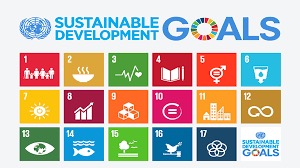
  1. Goal 2: Achieve Universal Primary Education 1. PTP ECOSOC Representative Abdul Rad held an event titled “Toward a World at School: Forum on Global Education” on May 4, 2015. Participants included several UN representatives including UN Youth Champion Monique Coleman, UN Youth Envoy Ahmed Alhendawi, UNESCO Initiative Secretariat Min Jeong Kim. ii. Culture of Peace Initiative 1. PTP is an officially designated Peace Messenger Organization (1987) and serves as the International Secretariat for the Culture of Peace Initiative (CPI). The CPI not only advocates for the SDG’s but also educates diverse organizations worldwide on various SDG’s and their implementation in civil society. The CPI in one of its functions serves as a platform to connect and mentor participants in all the world regions.

Mater Dei Prep, St. Mary students on mission to make global impact

By Jennifer Mauro | Managing Editor (Originally published in the Trenton Monitor)

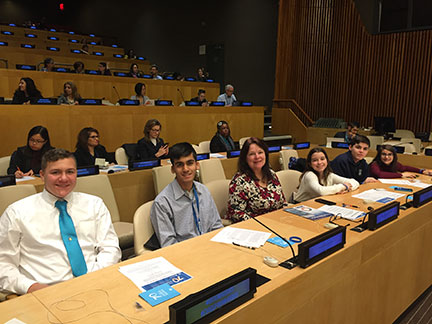
From left, Mater Dei Prep students Ashton Mejias and Ishan Sharma and St. Mary School teacher Rory Marchak and students Rachel Pfirrman, Noah Petry and Emma DeBiase attend a United Nations conference Dec. 10 in New York City. Sharma was one of only a handful selected to ask a question of the U.N. panel. Jennifer Mauro photos

“There is a mysterious cycle in human events. To some generations much is given. Of other generations much is expected.” ~ President Franklin D. Roosevelt

President Roosevelt may have been speaking to those of The Greatest Generation, but human rights activists believe the call to action is equally important to the young people of today.

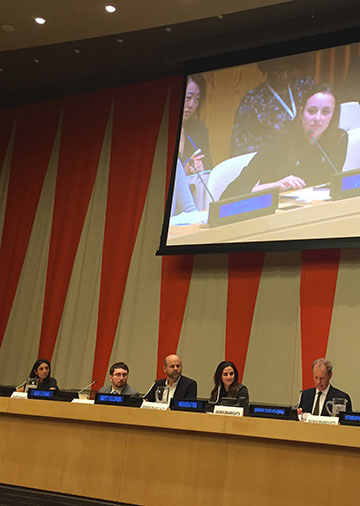
“As the gears of justice turn, we can take heart in the actions of youth around the country and the world to reclaim democracy,” said Alex Loznak, a fourth-year undergraduate at New York’s Columbia University and one of three panelists who spoke at the 70th anniversary of the Universal Declaration of Human Rights at the United Nations headquarters in New York City.

Related Video: Watch the U.N. Conference

Among the dignitaries, U.N. representatives and experts from across the globe poised behind microphones to ask the tough questions was a delegation from Mater Dei Prep’s Global Leaders Institute. The institute’s mission is to prepare students for leadership and positive change as part of their Catholic and Christian identity. The program is led by educator George S. Anthony, a parishioner of St. Mary, Middletown, and Pathways to Peace U.N. representative.

Mater Dei Prep senior Callan Laux, a member of St. Leo the Great Parish, Lincroft, addresses the U.N. panel, inquiring about collaboration between the U.N., civil society and youth when it comes to human rights.

No stranger to the U.N., the Middletown school students sat on the ground floor of the Dec. 10 discussion, which addressed human rights inequalities, climate change and new technologies.

“Do you have any specific ideas for a young person like me to best ensure human rights and its agenda are being upheld in my own community?” senior Ishan Sharma asked the U.N. panel in a strong, confident voice.

“I think the key word is contained within the question itself, and that is community,” responded Loznak, one of 21 youth plaintiffs who in 2015 filed a class-action lawsuit against the U.S. government to secure the legal right to a stable climate system. “It cannot be just individual actions and individual lifestyle choices, although those decisions are important. I think in any human rights issue – the community level is a very good place to start.”

Sharma is already putting that community-level service into action. He created a Red Cross club at Mater Dei Prep and is the fundraising manager for the Sayreville Red Cross. One of the goals, he said, is to educate the younger generation about the Red Cross and its services.

“If you want to work on a wider scale, start at the local level,” he said, echoing Loznak’s advice. “It’s not just an individual. It’s a community that has to encourage the human rights agenda. One person doing it is great, but if you have more people, it spreads.”

Fellow senior Callan Laux, a member of St. Leo the Great Parish, Lincroft, is all about forming alliances, too. “How do you all feel about a collaboration between civil society and the United Nations in order to create a universal, global human rights certification that youth can achieve in order to educate and get involved in human rights issues?” she asked the panel, which included Brett Solomon of Access Now, which advocates for human rights in the digital age, and Nadia Daar of Oxfam International, which works for economic equality.

Loznak was the first to respond. “I think that part of the path that many of us who are working on these issues begins with education … classes that we’ve taken in school, university … but also a path of self-education. I am very supportive of the construction of new platforms – including through civil society and a partnership with the United Nations – that can allow youth in a formal classroom setting or as individuals seeking out information on their own … to learn about these issues and be able to engage.”

Sherine Tadros of Amnesty International, which moderated the discussion, smiled as she addressed the Mater Dei prep students. “Just by you turning up today and asking these questions and about what you can do as a young person to defend human rights is very heartening,” she said.

Andrew Gilmour, U.N. assistant secretary-general for human rights, went a step further. “I think it’s clear that our generation has messed things up – both environmentally and in indeed in terms of human rights.

Basically, we look at you and people of your generation to try to put things right and how to do it.”

That’s a challenge the Global Leaders Institute students are ready to heed.

“I think we’re up for it,” Laux said. “We’re so much smarter than people give us credit for.”

Added sophomore Alexis Lombardo, “Don’t let others judge you based on who they think you are.”

Junior Dominque Bryson agreed. “I think sometimes people older than us devalue our opinion. So if we can create a platform for younger people to get involved, we should. It’s our future, too.”

Noah Petry, an eighth-grader in St. Mary School, Middletown – which shares a campus with Mater Dei Prep and intends to begin a similar group – said one of the causes he is most concerned with is equal rights and equal pay for women. “I really do think that is a major problem in our country and other nations as well,” he said. “I feel a responsibility to speak out on this situation.”

Fellow St. Mary School eighth-grader Emma DeBiase said just being at the United Nations made a difference. “I felt like I was part of the world instead of part of the United States. I felt more as part of a whole.

“Maybe when I grow up, I can become a U.N. representative, or the president, and help form those laws to have equal rights, equal pay, and most of all, make sure everyone has the life that they actually deserve, instead of the life the government thinks they deserve,” she said.

Sharma agreed. “The United Nations is not just a building. It’s a pathway to peace. You have a voice here. Human rights talks about everyone’s voice being heard. That’s what happened today. In a way, as we were speaking on human rights, we were also giving ourselves the human right to talk and be heard.”


Art of Effective Leadership and Communication in Diverse Global Environments

The Path to Win-Win

  • Life’s encounters can create difficult or challenging “dynamics”
  • Success will be based on your “choices” with each encounter
  • Today’s training will discuss the strategies towards creating win-win dynamics

K.Y.C Know Your Colleague

  • Know the people you interact with regularly.
  • Sometimes our minds are like a GPS on Automatic Pilot.
    Only going to what it already knows.
  • We can become prisoners of our own expectations.
  • To change the outcome, we need to change the direction.

View and Download the Complete Article Here: UN PP Global MHN


2018 UNCSW PTP62 Delegate Reports Summary

2018 UNCSW PTP62 Delegate
Reports Summary
New York, NY

March 11 – 23, 2018

This report is a summary of 12 individual reports, including 11 PTP delegates and 1 informal report from  Heart Ambassador who attended, David Dante.

Reports:

Sheva Carr – Script with opening exercise

*Cami Peterson-DeVries
Stephen Dinan
*Nancy Griffis
*MarySue Heilemann – PowerPoint presentation with links
*Shayndel Kahn
Devaa Haley Mitchell
*Sadhvi Siddhali Shree – Video slideshow
Erin Toppenberg
*Hudsyn Toppenberg
Jennifer Warren

* report contains photo(s)

In addition to “Women Illuminated” and “Women/Girls and the Media,” delegates attended and commented on a wide range of sessions, from Consultation Day to panels on UN grounds and the daily UN NGO Morning Briefings to receptions and a circle gathering.   To the person, delegates profoundly appreciated the UN CSW62 experience.  All reported new learning, being personally inspired, and mentioned the value of the connections they made through individual encounters. Conversations with presenters, other PTP delegates and people they happened to meet were among the most memorable moments,  especially those occasions meeting and getting to know other PTP delegates.

New collaborations, new projects and deeper relationships were  common themes.  A few examples: Stephen mentioned he is now filming dialogues for an online summit;  Siddhali is going to launch a podcast featuring the stories of advocates and survivors of human trafficking; Cami has already shared films with colleagues and others who work in the juvenile justice system,

While all the reports are interesting, inspirational, and contain evidence of unmistakable momentum toward gender equity and peace building, I would like to highlight three submissions I think might effectively be used as is or with minor editing to support an orientation of new PTP delegates or PTP might want to share more broadly with delegates and others.   They are the following:

  1. Sheva Carr: Contained in each introduction of panel members there is a concisely identified gender equality issue in the media  and a list of best practices
  2. MarySue Heilemann: The report is in the format of a PowerPoint presentation.  In addition to a pictorial presentation of the sessions MarySue attended, this report contains a comprehensive overview of  CSW, it’s place in the UN, the relevant structures and documents and historical milestones.
  3. Sadhvi Siddhali Shree:  The slideshow is accompanied by piano music inspired by the event, composed by Siddhali

For convenience, and ease (I hope), I have put individual reports into a mostly uniform format and incorporated all into one document with a table of contents. Because of the size of the file, MarySue’s PowerPoint can be accessed through a DropBox link.

It has been a joy to read these reports, each one a treasure.  Thank you.

Most Sincerely,

Nancy Griffis
Heart Ambassador
Pathways to Peace Delegate

View and download the complete report Here